Burnout vs Depression: How to Tell the Difference
“I think I’m just burnt out.”
I’ve heard that sentence a lot, and it’s doing two jobs at once. Sometimes it’s accurate. Often it’s a way of saying something is very wrong while keeping the word “depression” at a safe distance.
They’re not the same thing. They overlap enough to be genuinely confusing, and telling them apart matters — because what helps is different, even though some approaches help with both.
Here’s how to think about it.
A useful first question to ask yourself
If you take nothing else from this, take this.
Burnout is context-specific. Depression is pervasive.
Ask yourself: when you’re properly away from work — a week off, a proper holiday, a few days with no emails — do you feel any better?
If you feel meaningfully more like yourself after time away, and the dread returns as the return-to-work date approaches, that pattern may suggest work is contributing significantly to your distress.
If you take the week off and still feel flat, heavy, unable to enjoy things you used to enjoy, or emotionally disconnected from the people and activities that matter to you, that deserves attention too. These experiences can occur in depression, although they don’t establish a diagnosis on their own.
But here’s the important part: this isn’t a perfect test.
Burnout can affect your personal life, and depression can be closely connected to stressful circumstances, including work. Some people experience both at the same time. Others have symptoms that don’t fit neatly into either category.
Your experience deserves attention whether or not you can immediately identify the cause.
What burnout actually is
Worth knowing, because it’s routinely misdescribed.
In 2019, the World Health Organization included burnout in the 11th Revision of the International Classification of Diseases (ICD-11). However, it is classified as an occupational phenomenon, not a medical condition. It sits in a chapter covering factors that influence health status, alongside other reasons people contact health services that aren’t illnesses.
The WHO defines burnout as a syndrome resulting from chronic workplace stress that hasn’t been successfully managed, with three dimensions:
- Exhaustion — persistent physical or emotional depletion that may not resolve with ordinary rest
- Mental distance from the job — cynicism, detachment, negativity about work you once cared about
- Reduced professional efficacy — feeling ineffective, as though nothing you do makes a difference
Two things follow from that definition, and both matter enormously.
First, it’s occupational. The WHO is explicit that the term shouldn’t be stretched to cover other areas of life. You can be exhausted by parenting or caring for a relative — and that’s real — but burnout as defined is about work.
Second, and this is the part I’d underline: burnout is not a description of what’s wrong with you. It highlights the relationship between chronic workplace stress and your well-being.
That reframe matters because it changes the questions we ask. Instead of asking only, “Why can’t I cope?”, we can also ask, “What conditions am I being expected to cope with, and what needs to change?”
Why “more self-care” doesn’t fix burnout
If chronic workplace stress causes burnout, then the intervention is the workplace.
The research on this is fairly consistent. Leiter and Maslach’s six areas of worklife model describes burnout as arising from mismatches between a person and their job across six areas: workload, control, reward, community, fairness, and values. Too much work, too little say over how it’s done, insufficient recognition, isolation, unfairness, or being asked to work in ways that conflict with what you believe is right.
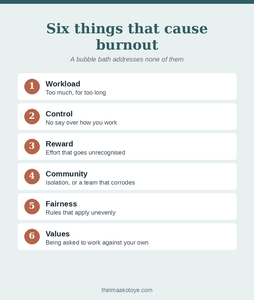
Look at that list and notice how few of them a bubble bath addresses.
This is what quietly frustrates a lot of healthcare workers, and I’m included. You say you’re drowning, and they offer you a resilience workshop. A mindfulness app. A wellbeing webinar — scheduled, of course, during your break.
None of it is worthless. But offering individual coping strategies for a structural problem locates the fault in the person, and that’s both inaccurate and demoralizing. You are not burning out because you lack resilience. You’re burning out because the demands exceed the resources, consistently, for a long time.
Rest helps. Rest alone, with nothing changed, means you return to the same conditions with a full tank and empty it again.
The goal isn’t simply to help you tolerate an unhealthy situation. It’s also to identify what needs to change.
What depression looks like alongside burnout
Depression is a health condition, and it has features burnout typically doesn’t.
Loss of pleasure or interest (anhedonia). This is one of the clearest dividers. In burnout, people can usually still enjoy things once they’re away from work — a meal out, their children, a Saturday. In depression, the enjoyment is gone from everything, including things that have nothing to do with work.
Pervasive low mood. You may feel sad, empty, irritable, or hopeless for much of the day, on most days. Sometimes the feeling is difficult to explain. Nothing in particular may have happened that day, yet getting through ordinary activities feels unusually difficult.
Feelings of worthlessness and guilt about who you are. Burnout usually sounds like “this job is pointless” or “I’m not making a difference here.” Depression sounds like “I am worthless” — not about the work, but about the self. You might find yourself thinking, “I’m a failure,” “I’m not good enough,” or “Everyone would be better off without me.”
That last one matters more than the others. If you’ve had thoughts that people would be better off without you, or that you don’t want to be here, please don’t file that under “stress.” It’s worth telling a health professional this week — not when things get worse.
The target of the negativity is the tell.
Physical and cognitive changes. You might struggle to fall asleep, wake very early and have trouble falling back asleep, or sleep much more than usual. Your appetite or weight may change. You may also experience difficulty concentrating, remembering things, or making decisions.
Thoughts of death or of not wanting to be here. This one is not a “wait and see” symptom. It warrants a conversation with a health professional now, not eventually.
A side-by-side comparison
| Burnout | Depression | |
|---|---|---|
| Does it lift away from work? | Often — you feel more like yourself | Usually not — it comes with you |
| Can you still enjoy things? | Usually yes, away from work | Enjoyment is gone from everything |
| What the thought sounds like | “This job is pointless” | “I am worthless” |
| How it’s classified | An occupational phenomenon (WHO) | A recognized health condition |
| What tends to help | Changing the conditions | Assessment and treatment |
They overlap, and they often coexist. This is a way of thinking, not a diagnosis.
They overlap — and often coexist
I don’t want to hand you a clean binary, because the reality isn’t clean.
Burnout and depression share a lot of ground: exhaustion, poor sleep, low motivation, difficulty concentrating, irritability. The overlap is substantial, and researchers still argue about where exactly the boundary sits.
The relationship runs both ways, and the evidence is genuinely mixed. Some longitudinal studies find burnout predicting later depression. Others find depression predicting burnout, or effects running both ways — and in several, the association shrinks considerably once existing depression is accounted for.
What’s clear is that they’re not alternatives. One can shade into the other, or both can be present at once. Someone can have a genuinely toxic workload and a depressive illness, and treating only one leaves them stuck.
Which brings me to the honest limitation of an article like this. I can describe patterns. I can’t tell you which one is yours. Only a conversation with someone who can ask you questions will do that.
What to do with this
If it lifts when you’re away from work, the work is the problem. Address the source. That might mean a conversation about workload, changing your shift pattern, setting a boundary you’ve been avoiding, or — sometimes, and I say this as someone who’s watched a lot of good clinicians reach it — leaving a role that isn’t going to change. That’s not failure. Recognizing an unwinnable situation is a skill.
If it follows you everywhere, please treat that as information rather than a character flaw, and get an assessment. Depression is one of the most treatable conditions we deal with, and the main thing that delays people is the belief that they should be able to fix it themselves.
If you genuinely can’t tell — and plenty of people can’t, because they haven’t had a proper break in years to run the test — that’s exactly what an assessment is for. If you’ve never had one, I’ve written about what actually happens at a first mental health appointment— every question, and why it’s asked. You don’t need to arrive with a diagnosis. “I’m exhausted, and I don’t know if it’s my job or me” is a perfectly good opening line, and clinicians hear it all the time.
Please don’t wait until you’re certain. The most common thing I see is people delaying because they’re not sure they’re bad enough to justify it. You don’t have to be bad enough. That’s not the entry requirement.
A note for the people in caring work
If you’re a nurse, a carer, a teacher, a social worker — you’re in the group most exposed to this, and also the group most likely to minimize it. Being the person who copes is often part of the professional identity.
Two things worth holding onto. Noticing this in yourself is a clinical skill, not a weakness. And no version of this delivers good care indefinitely from an empty tank — not because of a motivational poster, but because exhaustion measurably degrades judgment, empathy, and attention.
For the days when it’s acute rather than chronic, the 3-3-3 grounding technique is a one-minute tool worth having.
Taking care of this is part of the job, not a distraction from it.
This is general education, not medical advice for your situation, and it isn’t a diagnostic tool. If any of this sounds like you, please speak to your own doctor or a mental health professional. If you’re having thoughts of harming yourself, contact your local emergency number or a crisis line where you are — please don’t wait.
Frequently asked questions
What’s the main difference between burnout and depression?
Burnout is tied to your work and tends to ease when you’re genuinely away from it. Depression is pervasive — it travels with you, and removing the stressor doesn’t remove it. The clearest divider is whether you can still enjoy things unconnected to work.
Can you have burnout and depression at the same time?
Yes, and it’s common. They overlap substantially, and someone can have both a genuinely unmanageable workload and a depressive illness. Treating only one often leaves the person stuck.
Is burnout a mental illness?
No. The World Health Organization classifies burnout as an occupational phenomenon rather than a medical condition — it sits in a chapter covering factors that influence health, not the chapter covering illnesses. That matters, because it locates the problem in chronic workplace stress rather than in the person experiencing it.
Will taking time off fix burnout?
Rest helps, but rest alone rarely resolves it. If you return to unchanged conditions, you arrive with a full tank and empty it again. Lasting change usually requires changing something about the work—workload, control, recognition, or fairness.
Get more like this: Practical mental health notes from a working nurse — no fluff, no fear-mongering.
Get in touch: thelma@thelmaakotoye.com