The 3-3-3 Grounding Technique: How to Actually Use It
You’ve probably seen it on a pastel infographic somewhere: name three things you can see, three things you can hear, and move three parts of your body.
You may also have tried it in the middle of genuine panic, found it did nothing, and quietly concluded that grounding is nonsense for people whose anxiety isn’t that bad.
I want to explain why that happened, because the technique is rarely useless. It’s that nobody explained what it’s for.
First: what grounding is actually for
Here’s the misunderstanding at the heart of it.
Most people expect grounding to stop a panic attack. It isn’t designed to switch off a panic attack instantly. A panic attack is a powerful physical and emotional response, and grounding is better understood as a coping tool that can help you shift your attention while the symptoms pass.
Grounding gives your attention somewhere else to go while that happens.
That sounds like a downgrade. It isn’t. Because the thing that can turn a spike of anxiety into a full escalating attack is often your attention locking onto the sensations themselves — noticing your heart racing, thinking something is wrong with my heart, becoming more frightened, which can make the physical sensations feel even stronger. That’s the loop. Grounding can help interrupt the loop.
You’re not switching off the alarm. You’re stopping yourself from feeding it.
Once you’re aiming at the right target, the technique stops feeling like it failed.
How the 3-3-3 technique works
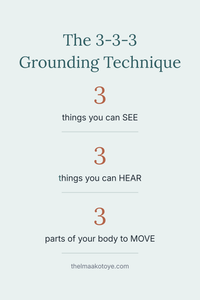
Three steps, in order:
Three things you can see. Look around and name them, specifically. Not “a wall” — “the chip in the paint near the door frame.” Specificity matters, and I’ll explain why in a moment.
Three things you can hear. Again, specifically. Traffic outside, the hum of a fridge, someone’s footsteps upstairs. If it’s genuinely silent, listen for your own breathing.
Move three parts of your body. Roll your shoulders. Flex your fingers. Press your feet into the floor. Rotate your ankles.
That’s it. Thirty seconds, maybe a minute.
Why the specificity matters more than you might think
This is the part that gets left off the infographic.
“A wall” takes almost no cognitive effort. Your anxious mind can name it and keep catastrophizing underneath. “The chip in the paint near the door frame, about the size of a coin” requires actual attention. You have to look, focus, and find words.
That effort is part of what makes the exercise useful. You’re not being soothed by the wall. You’re deliberately occupying your attention with something concrete that would otherwise be running the disaster loop.
The same idea applies to the movement step. Rolling your shoulders can give you a deliberate physical action that requires you to notice your body in the room, which can help bring your attention back to the present moment.
Practical implication: if you’re doing it fast and vaguely, you’re probably not getting as much from it. Slow down. Be boringly specific. It should take a little effort.
The numbers don’t matter — and that’s useful
3-3-3, 5-4-3-2-1, or counting backward from 100 in sevens. Different grounding exercises use different combinations of sensory awareness, attention, and physical movement.
Knowing that frees you up considerably.
If you’re in a meeting and can’t roll your shoulders, press your feet into the floor and name things you can see. If you’re in the dark, use sound and touch.
If you’re driving — and this matters — don’t close your eyes or deliberately distract yourself from the road. Your priority is to drive safely. If you need to, pull over somewhere safe before trying a grounding exercise.
You’re not performing a ritual. You’re using a coping strategy, and you can adapt it to wherever you are.
Where the evidence actually stands
I want to be straight with you, because health content usually isn’t.
There is no large clinical trial of the 3-3-3 technique specifically. It’s a popularised version of a broader family of grounding and sensory-focusing techniques used within therapies like CBT and trauma-focused work.
What there is: evidence supporting attentional refocusing and sensory grounding as components of established approaches, some measured work on sensory grounding and physiological stress, and research on closely related grounding exercises, including a 2025 trial of the five-senses protocol in nursing students showing significant reductions in anxiety.
So: well-supported ideas behind the approach, popularised packaging, no large trial of this exact version. That’s an honest picture.
It’s also free, simple to try, and takes about a minute — which makes it a practical coping tool for many people.
What it is not is a treatment for an anxiety disorder. It’s a tool for a moment. If you’re having panic attacks regularly, the tool is for getting through them while you get proper support — not instead of it.
The mistake that makes it fail — and how to fix it
Here’s the one that matters most.
It’s much harder to learn and remember a new skill when you’re in the middle of intense panic. In that state, your attention can be hijacked, and your ability to process something unfamiliar can be reduced.
Trying grounding for the first time mid-panic is like trying to read the manual while the fire is burning.
That is why it can feel like it “doesn’t work” for people who only try it at the hardest possible moment.
Practice it when you’re calm. Once a day, for a week or two. Standing at the kettle, waiting for a bus, sitting in your car before a shift. It’ll feel pointless — that’s fine, that’s what practice feels like.
What you’re building is familiarity and automaticity. You want it to be something your body does without much instruction, like how you don’t think about unlocking your phone. Then when panic arrives, you’re not learning. You’re recalling.
This is one of the highest-return things in this entire article.
How I think about grounding
When I explain grounding, I don’t tell people to perform it perfectly.
I tell them to give their attention a job.
Look at something properly. Listen for something specific. Feel your feet on the floor. Notice what is around you.
The goal isn’t to make the anxiety disappear immediately. It’s to stop giving every sensation and anxious thought your full attention.
That’s a much more realistic expectation — and for many people, a much more useful way to approach the technique.
Four more things worth knowing
It might feel awkward. It can feel silly to deliberately name things around you, especially when you’re perfectly calm. That’s okay. The goal isn’t to look impressive. It’s to give your attention something concrete to do.
It won’t work every time. Some attacks are too far along. That’s not failure, and treating it as failure adds a layer of self-criticism you don’t need.
It works better early. Learn to catch the ramp-up — the tight chest, the tunnelling attention, the “something’s wrong” feeling before it becomes a thought. Grounding may be more useful at that stage than waiting until you’re fully overwhelmed.
Pair it with a slow exhale if that feels comfortable. A longer out-breath engages the parasympathetic nervous system — the body’s brake. You don’t need to take deep breaths or force anything; simply breathe in comfortably and let the exhale be a little longer and slower. If focusing on your breathing makes you feel more anxious, leave this part out and stick with the grounding exercise.
When it’s not enough
Grounding is a coping tool, not a treatment. Talk to a health professional if:
- Panic attacks are happening regularly, or you’re increasingly afraid of the next one
- You’ve started avoiding places or situations to prevent them
- Anxiety is interfering with work, sleep, relationships or eating
- You’re using alcohol or anything else to manage it
- You’ve had chest pain or breathing symptoms that haven’t been medically checked — panic and cardiac symptoms can overlap, and that needs ruling out properly
If you are experiencing severe or new chest pain, severe difficulty breathing, fainting, or symptoms that feel different from your usual panic symptoms, seek urgent medical attention.
If the exhaustion is constant rather than episodic — there most days, rather than arriving in waves — burnout vs depression may be the more useful read.
Panic disorder responds very well to treatment. Managing alone with a grounding technique when effective treatment exists is a hard way to do it.
This is general education, not medical advice for your situation. If anxiety or panic is affecting your daily life, please speak to your own doctor or a mental health professional. If you’re in crisis, contact your local emergency number or a crisis line in your area.
Frequently asked questions
What is the 3-3-3 grounding technique?
It’s a short attention exercise: name three things you can see, name three things you can hear, then move three parts of your body. It takes under a minute and needs nothing but wherever you happen to be standing.
Does the 3-3-3 technique stop panic attacks?
It isn’t designed to. Think of it as something to do while a panic attack runs its course, rather than a switch that ends one. That distinction matters, because expecting it to stop panic is the most common reason people conclude it doesn’t work.
When should I use the 3-3-3 grounding technique?
It tends to help most at the first signs of anxiety building — the tight chest or narrowing attention, before things escalate. It’s also worth running through on ordinary, calm days so the steps feel familiar when you need them.
What if the 3-3-3 grounding technique doesn’t work for me?
Try adapting it rather than abandoning it — use different senses, change the movements, or switch to counting backward. And if anxiety or panic attacks are regularly affecting your daily life, grounding shouldn’t be carrying that weight alone; it’s worth a conversation with a health professional.
A final thought
Grounding doesn’t have to make your anxiety disappear to be useful.
Sometimes the goal is simply to give your attention somewhere else to go.
Three things you can see.
Three things you can hear.
Three parts of your body you can move.
Simple doesn’t mean pointless.
And if it doesn’t work the first time, that doesn’t necessarily mean you failed. You may simply have been trying to learn the skill at the exact moment when learning something new was hardest.
Practice calm. Use it when you need it.